




Multi-stakeholder effort to improve the sustainability of a fishery. Requirements pertaining to participation, funding, transparency, and scientific rigor.

The National Fishermen Producers Co-operative Ltd. is committed in all aspects of the organization to provide local and international seafood consumers with safe and high quality products. For this to be possible NFPC has implemented a HACCP system for product safety and quality. The system is consistent with the society’s goal for continuous improvement and customers’ satisfaction.
For the last 70 years, commercial fishing has been a major contributor to the Belizean economy. The colony of British Honduras began exporting fisheries products to the United States and neighbouring countries in Central America beginning in the early 1900s. Over the last thirty years annual exports of seafood have risen to an average of $20 million BZD and the industry has contributed on average of 3% – 5% to Belize’s GDP. Additionally, the artisanal nature of the sector lends that fishing is of significant socioeconomic importance for a large section of the Belizean society.
The National Fishermen Cooperative Society (NFCS) Limited is the second largest fishers’ cooperative in Belize, with operations and receiving facilities in Belize City and Placencia. NFCS was registered in 1967, and as of May 25th, 2017, has a membership of 257 producing and 270 non-producing members. On February 7, 2019, NFCS successfully submitted a grant application to the Marine Conservation and Climate Adaptation Project (MCCAP) entitled: ‘’Improving the efficiency, productivity, and profitability of the National Fishermen’s Cooperative Society Limited.’’
The National Fishermen Producers’ Cooperative (NFC) is Belize’s second largest fishers’ cooperative and it comprises a total of 530 members. The NFC operates principally from Belize City but it also maintains receiving facilities in Caye Caulker, Riversdale and Placencia, to which approximately 150 non-members sell their products. The members of the NFC or its fishers own the cooperative and they elect a managing committee. This managing committee serves as the Board of Directors (BoD) of the NFC.

Impacts to the cooperatives and international markets
The Tally electronic traceability system developed by ThisFish captures specific product data collected at the National Fishermen Producers Cooperative Society Ltd (‘National’). This is used to track product through the supply chain to; a) reduce operational costs by modernising administrative processes; and b) pave the way towards opening new markets.
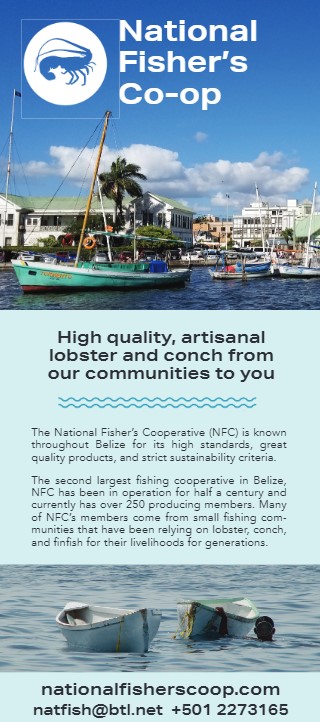
The National Fisher’s Cooperative (NFC) is known throughout Belize for its high standards, great quality products, and strict sustainability criteria. The second largest fishing cooperative in Belize, NFC has been in operation for half a century and currently has over 250 producing members. Many of NFC’s members come from small fishing communities that have been relying on lobster, conch, and finfish for their livelihoods for generations.
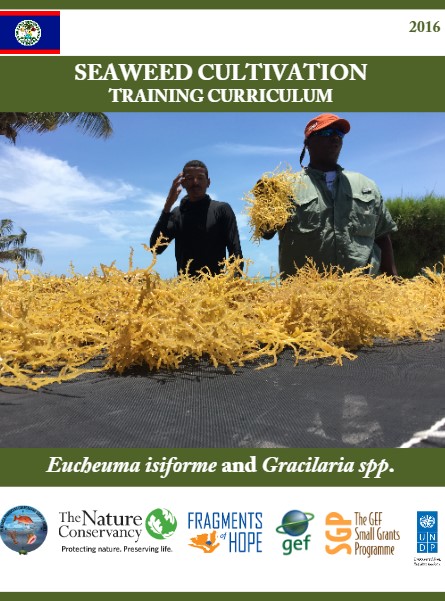
In a response to inspire the fisheries sector to transform fisheries management, reach new markets, and leverage accessibility of fishers to finance for investment in sector innovation to improve livelihoods, the Fish for Life program was developed in 2013. A national level plan made for fishers by fishers.
Good management practices are important in ensuring the safety and quality of the product, as well as ensuring the health of the environment. It is our hope that this manual serves well in ensuring proper management of the new industry.
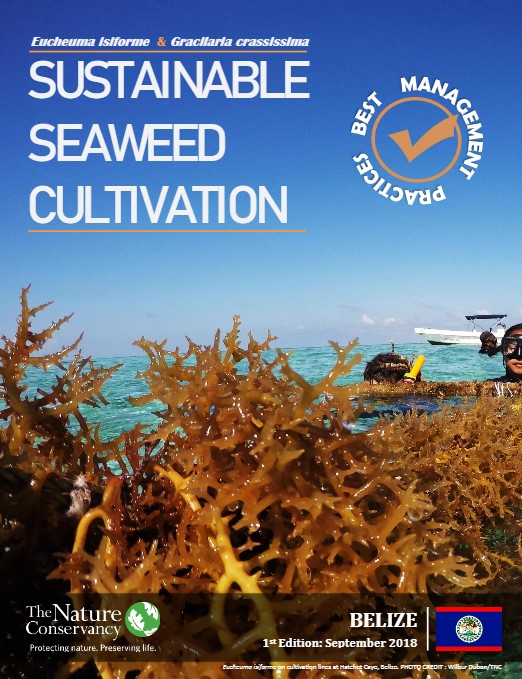
Seaweed cultivation was identified as a viable alternative livelihood activity in the national Economic Alternatives and Fisheries Diversification Plan –Fish for Life plan. As the level of interest for seaweed cultivation grows countrywide, so does the need for the establishment of proper methods and guidelines to ensure that current and future developments are in line with the principles of sustainable seaweed cultivation.This guideline is therefore for establishing and maintaining sustainable seaweed mariculture farms in Belize, both in marine protected areas, and non-marine protected areas. It serves as a guiding document for the full training program which all seaweed farmers are required to participate in, prior to the establishment of farms within the waters of Belize. The contents in this documentare based on best management practices that have been identified as relevant to Belize, and that exist to ensure optimum socio-economic and ecological benefits, while ensuring minimal negative impacts. It is our hope that this guideline and associated training program will assist in the diversification of the fisheries industry of Belize.
12
Page 1 of 2